


Was it ever so easy so judge the performance of Italy in a world cup? Not in the last 54 years at least. And this tells you why it is a complete failure (well, the fact that both the coach and Federal President resigned might give you a hint too): Italy were knocked out of two consecutive World Cups in the group stage, like only in 1966 (1962 and 1966), when the defeat vs. Korea became part of Italy’s lexicon to describe a “disastrous defeat”. Can we say Italy did its best to avoid all this? Well, this explains the second yes: 1 shot on goal in 90 minutes, zero shots on goal since trailing 1-0. So yes, it is deserved. And finally, was it really our fault? If you lose to Costa Rica and Uruguay, which, with all due respect, have half the general talent of Italy, who’s fault can it be? The ref’s? Please…
A tactical analysis Italy entered the game with a mild optimism, as they could settle for a draw and still go through. Under a tactical point of view, the Azzurri played with a very “black-and-white” 3-5-2, with Juve’s rearguard (Barzagli, Bonucci and Chiellini in front of Buffon), two fullbacks on the wings (Darmian and De Sciglio), a quality midfield with Pirlo, Verratti and Marchisio, and a theoretically very productive pair of strikers in Balotelli and Immobile.
What seemed immediately clear is that the Azzurri were missing something: movement. Balotelli often went as far as Italy’s midfield to get the ball, leaving Ciro Immobile by himself up-front. This is nothing new for the once (or never?) Super Mario, as the president of his current club has repeatedly insisted that he should play closer to the box (actually, in the box). This way, however, Italy had a hard time in finding a point of reference in the box that could keep the ball and allow the team to advance. In addition, with Pirlo and Verratti who seemed inspired, and who could alternatively start the play whenever the other was pressed by an opponent (not very often really), there was no one (not Balotelli, and in very few occasions Immobile) who tried some movements towards the goal without the ball. The two brains of Italy must have felt frustrated, especially as Bonucci became more and more the third option, with long balls that only Immobile tried to catch (Balotelli had 0 aerials in his game), with negative results (17% aerials won against Godin’s 83%).
Despite this, Prandelli’s team showed an unprecedented defensive solidity, and for the first time they gave the impression that they could actually keep a clean sheet: Cavani and Suarez, in fact, were almost never a threat in the first half, and Uruguay in general only created some goal opportunities when exploiting the flanks, where Darmian and De Sciglio weren’t as effective as hoped, and where any 3-men defense would suffer the most if not supported well by the wingers.
Everything changed after Marchisio’s red card in the 60th minute. Or better, everything changed after Uruguay’s goal in the 80th minute- a lucky header (more of a "backer") by Godin-, because the South Americans only had a couple of chances with Suarez up one man, saved very well by Buffon. The game could have ended 0-0, but fortune favors the bold, and the only team that has ever tried to win the game was la Celeste.
Italy actually found themselves with 15 minutes to play, down one goal, and with no striker up-front, as Prandelli took out Immobile for Cassano, while Balotelli- almost annoying for his lack of determination- had nervously left the game for Parolo at half time. With Verratti cramping out, the contropiede (counter-attack) of Italy was often led by his sub, Thiago Motta, who is no champion of speed. As a result, Italy never shot once on goal in those final minutes. Overall, the game could have ended differently and the result could have smiled at Italy, but to me all this is fair. If you cannot produce more than a single shot on goal in open play in 135 minutes (second half with Costa Rica plus Uruguay’s game), you do not deserve a spot in the last 16.
The scapegoats Having said this, after such a catastrophic failure it is inevitable to point fingers. The scapegoat is usually one of two and sometimes both: the coach and the ref, i.e. Cesare Prandelli and (surprise surprise) referee Rodriguez.
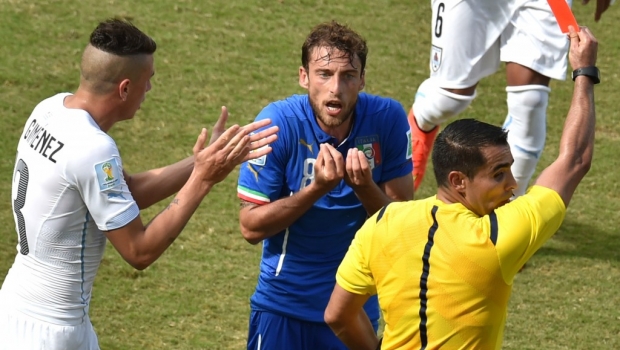
Starting from the latter, he did a good job. He has absolutely no responsibility for Italy’s elimination. The only mistake he might have done is not sending off Suarez, but to be honest, it isn’t 100% clear (though deep in our hearts we all know he did bite Chiellini) what happened after re-watching it on telly, so how can we expect him to see that very quick, Draculesque episode? Other than that, Marchisio’s red card is unquestionable to say the least. There’s no way you can tackle an opponent with your foot on his knee and come out clean. I’m sure Marchisio didn’t want to hurt his Uruguayan counterpart, but he wasn’t mentally fresh enough to avoid such a challenge under the ref’s eyes, who was right there to see the whole scene from a privileged angle.
After the ref, the main culprit is always the coach. After all, Italy is known for its 60 million football managers. And out of 60 million, it is hard to find two with the same view. This is before a game. After a game, instead, everybody unanimously agrees on what the CT (stands for Commissario Tecnico, how Italians call the National team’s coach) could have and should have done.
My premise is that I will try not to be just one of the 60 million (maybe I’m just overly ambitious). Ex-post everything’s easy, but there are at least a few mistakes that stand out.
First of all, Prandelli can be blamed for Italy’s tactical instability: three games, three different formations, two different tactical schemes. Furthermore, the one that seemed to be the most effective was the one used in the final game. One could argue that he lacked the right men (De Sciglio was injured for the first two games, and Abate was manifestly unsuitable), but then again, he left home Giuseppe Rossi, i.e. the most experienced striker of the team, because he was not fit yet: couldn’t he wait for him too like he did with De Sciglio, since the team produced only two goals in 3 games? Considering the importance of the fullbacks in his game, why did Prandelli fly to Brazil with only Darmian, De Sciglio and Abate, that is two young promises and a player whom the most hardcore Milan fan would leave out, not of his team, but of his door if he were to meet him on the street? Why not even consider Domenico Criscito?
Why Cassano, a player that was left out after Euro 2012, and that had had problems with half of the locker room? Why Paletta, a player that played only a single friendly game in March, and isn’t even Italian! I won’t ask why Balotelli, because it would be too easy now. Almost nobody would have left him out before the World Cup. However, judging by Buffon’s and De Rossi’s post-match words, Prandelli most of all didn’t do a good job in creating not just a team, but a group. Those words (“we don’t need characters, we need men”) sound as a direct charge to the rising stars, who are yet to shine on the big stage. And a team that’s split in two does not have a future. Frankly, Prandelli’s confusion in incomprehensible, when he should have simply kept his line, but obviously now it’s too easy.
He resigned instead, and that’s admirable in Italy where people are usually “stuck to their chairs”. Even more as his resignation caused Giancarlo Abete’s too. This means that today Italy are missing both a coach and a Federal President. As negative as the situation might be- and it’s very bad, as- we repeat- Italy hadn’t failed to qualify to the second stage of the Cup for two consecutive editions since the 60s- Italy has a chance to rebuild. In the 60s, we closed our frontiers, not allowing foreign players in for over a decade. This led to a WC final in 1970, a semi-final in 1978 and a title in 1982. This isn’t possible today, but something has to be done.
This national team is the mirror image of the current Serie A. Now the Italian football movement has to decide what they want to become. They either become like, for example, Uruguay, and start exporting all of their talents abroad to the best leagues in the world to gain experience (not an option), or they start fighting back the competition of the other Big-4 leagues, if not with money- which is missing right now- with local players, giving them the chance to grow and flourish, and not just warm up the bench while watching the Alvaro Pereiras or the Keisuke Hondas play. If you cannot buy the best foreign talents- and Italian clubs are not in that position now-, why waste money on second-tier players, more expensive and often with lower ceilings? Therefore yes, it is also up to the clubs, which should work together with the Federation like German clubs did in the early 2000s, after their Euro 2000 debacle. The recent slow, albeit constant decline must be stopped now.
The mighty years of Serie A- the 80s and 90s- were actually born in the 1960s, when a failure was transformed into an opportunity. Can Italy do it again?
Wednesday, June 25 th, 2014
For discussion of this topic and many more, join more than 10,000 fans at R/Football

Tags:


